

Design inspiration comes in many forms: architecture, nature, and the human body. It is a continuous process of sharing and iterating ideas — refining them until the desired result is achieved. With the Pasadena Collection, David Moser infused motifs from Alvar Aalto, Sam Maloof, and existing Moser designs to create a collection that is both functional and artistic.

Above: Pasadena Rocker and Hartford Side Table
Inspiration
Much of Pasadena’s design ethos finds its roots in post-WWII Scandinavia, where Danish designers sought to improve people’s lives by creating affordable furniture and household items that were functional and elegant. During this post-war era, Scandinavian designers drew inspiration from the forests and traditional handwork while embracing modern technology.

Above: David's initial sketches of the Pasadena leg design.
Alvar Aalto, a Finnish architect and designer, drew upon these modern principles, creating furniture that humanized familiar forms through unconventional use of the material. His exploration of wood bending and shaping defined an era of furniture design that incorporated gentle curves, organic shapes, and rounded edges with a minimalist appeal. These graceful elements captured David’s attention.

Left: The Pasadena Leg. Right: Alvar Aalto design.
As David Moser began drafting the first sketches of the collection, he did so with an eye to the future and began embracing a new era on the design continuum for Thos. Moser —one where cutting-edge design would become a marriage of technology and handcraft. As CNC (computer-numerical control) technology was about to be introduced, David designed the collection in anticipation of the machine’s capabilities, integrating compound angles and complex components. However, building the piece would still require hours of skilled handwork to achieve its sculptural beauty.

Above: David Moser works on a sculpture beside the Pasadena Rocker in the shop.
A Designer’s Interpretation
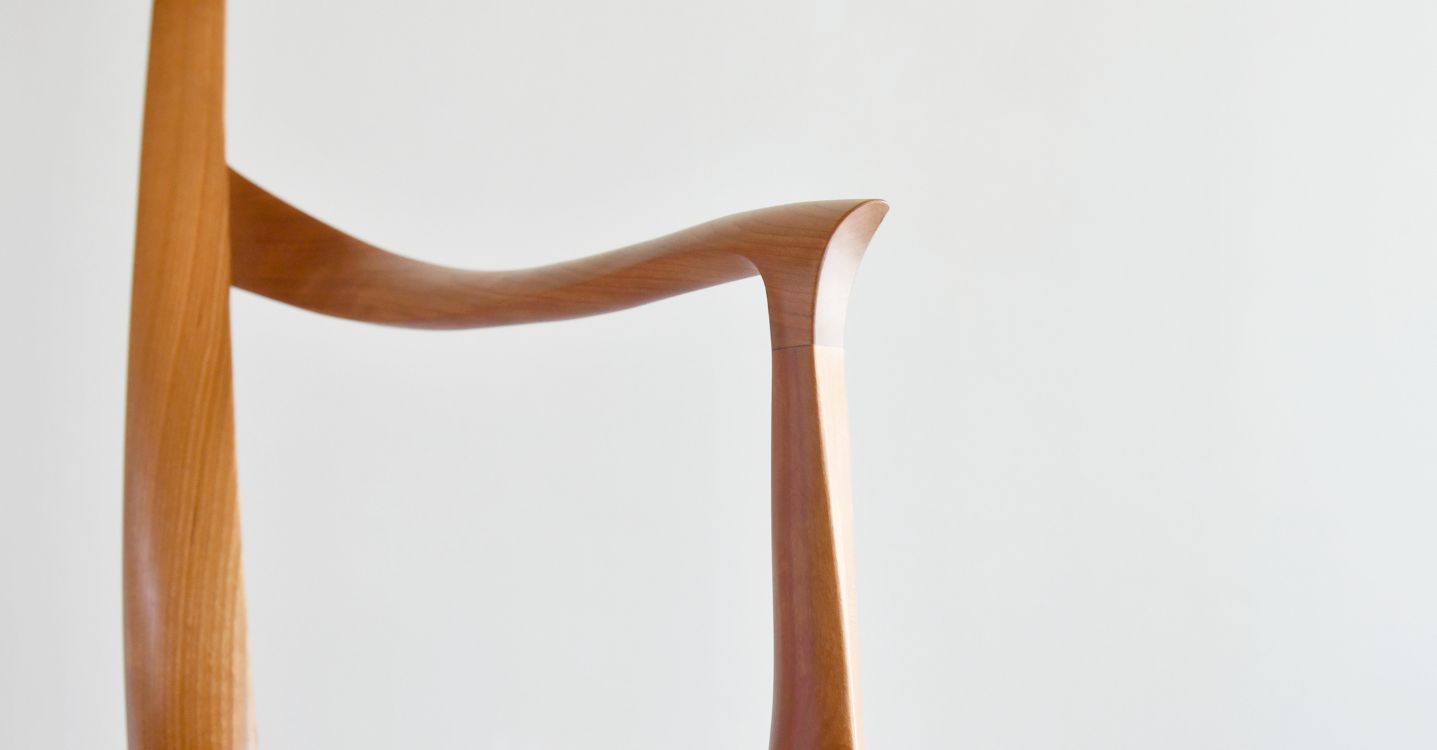
Like the Danish designs, David’s Pasadena Collection was instantly recognized for its sculptural qualities and uncompromising comfort. Pasadena embraced softer edges and sloping lines in the legs and arms of the chair. With his sculptor’s eye, David revealed a new, softer aesthetic where all joinery and hard lines would be blended to make the furniture appear as though it was sculpted from a single piece of wood. The artistic interpretation drew similarities to the human form- particularly the feminine form.

Above: The arm of the Pasadena Rocker.
As a designer, he knew the exact height at which the touch points of the back splat and the frame needed to curve inward to provide aesthetic beauty and support the sitter’s lower back. The same applies to the highly sculpted seat that cradles the human form, creating a solid wood seat that is comfortable to sit in for hours at a time.

Pasadena Hall Table in cherry.
“The Pasadena Collection showcases how we balance artistic expression and a designer’s know-how.”
-David Moser

Above: Pasadena Side Chair
A Design Comes to Fruition
Pablo Picasso said, “Inspiration does not exist but must find you working.” While that’s true in a creative field like furniture-making, a new design can sometimes emerge spontaneously and fully formed. However, it is more common to be on the workbench before the balance and the perfect form in one’s mind emerge.

Above: The rockers on the Pasadena Rocker.
Often, the more original the design, the longer the experimental process. Respect for this discipline gave David the freedom to build and rebuild the Pasadena designs until he knew they were right. He began exploring the nuances of the chair form using hand tools and state-of-the-art technology to see what kind of movement he could coax out of solid wood. He intended to build a quintessentially functional Moser piece with edges and joints that flow and sculptural surfaces that encourage the eye to roam. From that genesis, the entire Pasadena Collection evolved into its sculpted state.

Above: Pasadena Rocker detail.
The Pasadena Rocker exemplifies sublime form and sheer simplicity. The rocker’s form begins at its base, where twin rockers seem to grow into its hand-finished legs, which rise to frame both the back and the arms. Every surface of the chair is perfectly hand-sculpted, and every connection is skillfully blended, where the radius of each point creates a symbiotic relationship with the next edge, resulting in fluid lines that evoke motion. The deeply carved seat is worked by hand and refined to create a comfortable wooden seat for hours of relaxation. Employing the CNC, the back splat is carved from a single block of wood to create the S-curved contour that perfectly supports the sitter’s spine, and the faceted and splayed legs add a modern, geometric hourglass shape to the entire collection, providing stability without the bulk.

Above: Pasadena Hall Table, Pasadena Dining Chairs & Georgetown Double Pedestal Table in walnut.
As the new design launched alongside the opening of our Los Angeles Showroom in the early 2000s, he named the collection Pasadena. Firmly rooted in an anthropomorphic design, the collection showcases wood’s unmatched strength and grace. It tells a story of captured movement, with flowing curves coalescing in a collection that straddles the line between art and utility.


