

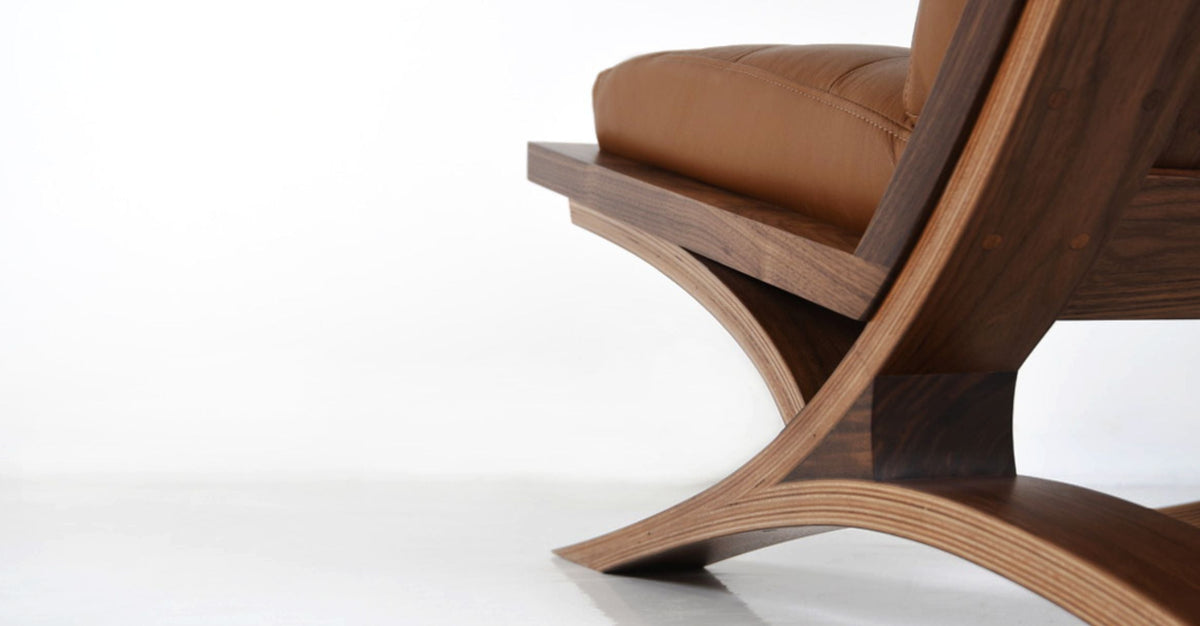
Curves have long been part of furniture making. They appear in the apron of a table, the frame of a bed, and the crest of a chair. In wood, a curve can be cut, steam-bent, or laminated. At Thos. Moser, we use each method according to the form and structure of the piece. For laminated curves, we turn to Bob Cabral, a craftsman at Thos. Moser for more than 30 years and has made every laminated curve found in our furniture. Bent lamination brings together thin layers of wood, glue, pressure, and time. The result is a strong, stable component capable of taking on forms that could not be achieved from a single piece of solid wood. It is a process in which material, structure, and form are considered together.

What Is Veneer?
Veneer is a thin slice of wood. It can be produced by plain slicing, rotary cutting, or quarter-sawing. Bob works with plain-sliced veneer, which follows the growth of the board and reveals its natural grain pattern. For the lamination process, Bob begins with the same solid wood used throughout our furniture. A board is resawn into thin slices, or plies, then passed through an abrasive planer. Each piece is measured with a caliper until it reaches the required thickness, generally about 1/8 inch.
The veneer is kept in a humidified room to maintain its flexibility. As Bob explains, without sufficient moisture, the thin wood can dry, crack, and become difficult to bend. For lamination, pliability is essential. Veneer is sometimes associated with a thin decorative layer applied over a lesser material. That is not how we use it. Our laminated components are made from sequenced flitch veneer: thin plies are cut from the same high-quality boards used in our furniture, then returned to their original sequence and glued together. The result is a solid wood component that can be formed into a curve while maintaining its strength and continuity.
The process can be seen clearly in the Vita Collection, where a continuous curve defines the form. To create the veneer for the Vita Bed, Bob begins with a single board and resaws it into approximately six slices. Each slice is then brought to the required thickness before the lamination begins.

The Process of Lamination
At Thos. Moser, bent laminated curves are made using two processes: radio-frequency pressing and cold pressing. The radio-frequency press uses high-frequency energy to cure the glue between the layers. The process takes approximately thirty seconds. Each piece requires its own jig, made specifically for the form. Cold pressing uses forms and molds to shape the layers. Depending on the component, the glue can take up to eight hours to cure.

Both processes begin in the same way. Each veneer is cut to size and checked for thickness before the glue is applied. Bob works quickly, spreading the glue by hand and stacking each layer in sequence. Water is misted onto the veneer as needed to maintain the flexibility of the wood and glue until the desired thickness is reached. The method depends on the size and form of the component. Both produce a strong, durable laminated curve.

In Finished Form
Some of the most distinctive forms in our furniture depend on this process. The components of the Chaise are large and complex, requiring cold-process lamination. At least nineteen layers of veneer are assembled for each component. Once the glue-up begins, Bob has approximately seven minutes to complete the stack and place it in the press. In warmer, drier conditions, that window becomes even shorter. The work demands speed, but not haste. Each layer must be placed accurately, and the entire assembly must reach the press within the working time of the glue.

“The Chaise is my favorite to make, just because it’s a challenge. Especially during the change in seasons. It keeps me on my toes, and I enjoy it.”
— Bob Cabral
The defining arch of the Vita Collection, the structural form of a ship’s knee, and the curved frame of the Chaise each depend on the possibilities of bent lamination. Thin layers of wood, returned to their natural sequence and shaped together, become something stronger than the individual pieces themselves. The process allows the wood to move through a curve while retaining its structure, grain, and character. It is one more example of what can be achieved when material is understood, the process is respected, and the work is given the time it requires.


