

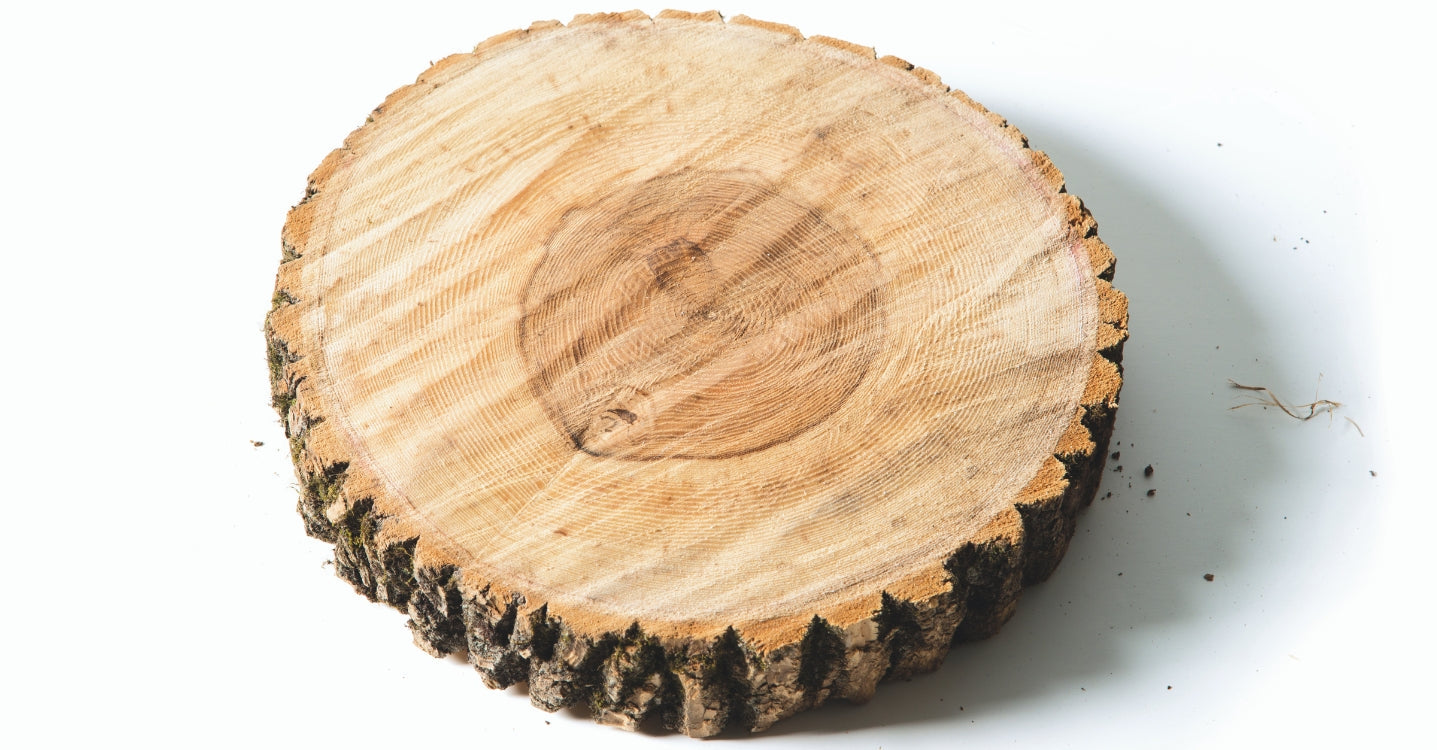
With its straight grain and exceptional strength, ash has long been a staple in the legs of chairs, rockers, and benches throughout our collections. Balancing its strength, ash is also remarkably resilient– providing just the right “give” to make a spindle Thos. Moser chair back is every bit as comfortable as it is beautiful.

Tensile Strength
What is this “give” that makes ash so desirable to use for making spindles and legs? It’s known as tensile strength or the elasticity of the material. Every piece of wood, metal, glue, fiber, and even our own hair has tensile strength. It is a measure of how much pressure or stress can be applied to any one element before it breaks.
Tensile strength is the maximum stress or force a material can withstand while being stretched, pulled, or absorbed before breaking. Ash is an optimal choice for furniture makers for legs and spindles, as it can be bent and manipulated while maintaining its strength. In addition, ash is not as heavy as other hardwoods, making it perfect for creating a chair that is built to withstand everyday use, without being cumbersome.

Characteristics of Ash
Ash, or Fraxinus, is in the same family as the olive and lilac trees. Named for its spear-shaped leaves, the ash tree has over a dozen varieties that grow throughout the Eastern United States and Canada, the most common being green or white.
Color
Ash is generally a light-colored wood, and it can often be difficult to see where the sapwood and the heartwood begin. However, the sapwood- or the outermost part of the tree- varies from a white to a creamy golden color, and the heartwood – or the innermost part- can be a light color to a darker brown color. Over time, the creamy color of ash will age into a dark golden hue.
Strength
Ash is considered a “hardwood,” as are the cherry and walnut used in our furniture. However, the terms “strength” and “hardness” of wood are incredibly ambiguous. That is to say, there is more than one way of determining the strength of the wood and its application. The bending strength (when the weight is placed perpendicular to the grain) of ash is 15,000 psi. In contrast, cherry is 12,300 psi, and walnut is 14,600 psi. The hardness of ash (determined by engineers driving a metal ball halfway into the wood’s surface) is 1,320 lbs of force, compared to 490 lbs for cherry and 1,010 lbs for walnut.

Grain patterns found on ash spindles.
Grain Pattern
Ash contains a relatively smooth and straight brown-beige grain pattern giving it a neutral palette that complements the varied grain patterns of cherry and walnut. Though it is generally known for its straight grain, conditions in its environment- soil, moisture, pests- can result in figured or spalted ash.

Building Furniture for a Lifetime
When we build furniture, we do so with the utmost respect for the materials. We employ its natural strength and do so with the keen eye of a master craftsman. And in doing so, we carefully select wood that will dutifully withstand the rigors of daily life. As a natural polymer, wood resists stress by distributing the load along the length of a given board. We follow its lead, using the grain's natural cathedrals as ornamentation that enhances our aesthetic. For us, ash’s tenacity and durability to withstand a lifetime of use in our chair legs and spindles make it the right wood in the right place.


