

Very few of us can remember a turning point in our careers as vividly as Thomas Moser did. It was a cool September morning in 1971 as the brilliant late summer sun beat down on a table he had just built and brought up from his dingy cellar workshop. Freshly finished with boiled linseed oil and hand-rubbed wax, the table practically glowed. A friend's wife stopped by, saw the table, and offered to buy it on the spot. It was just one moment, but it was also an epiphany in the truest sense of the world. In an instant, at age thirty-six, Tom knew he had enough artistry to produce something people would appreciate and buy. It wasn't long after that that he said to his wife, Mary," I am going to quit teaching. I am going to make things out of wood." She fully agreed.

Thomas Moser standing outside the Grange Hall in New Gloucester, Maine.
A Leap of Faith
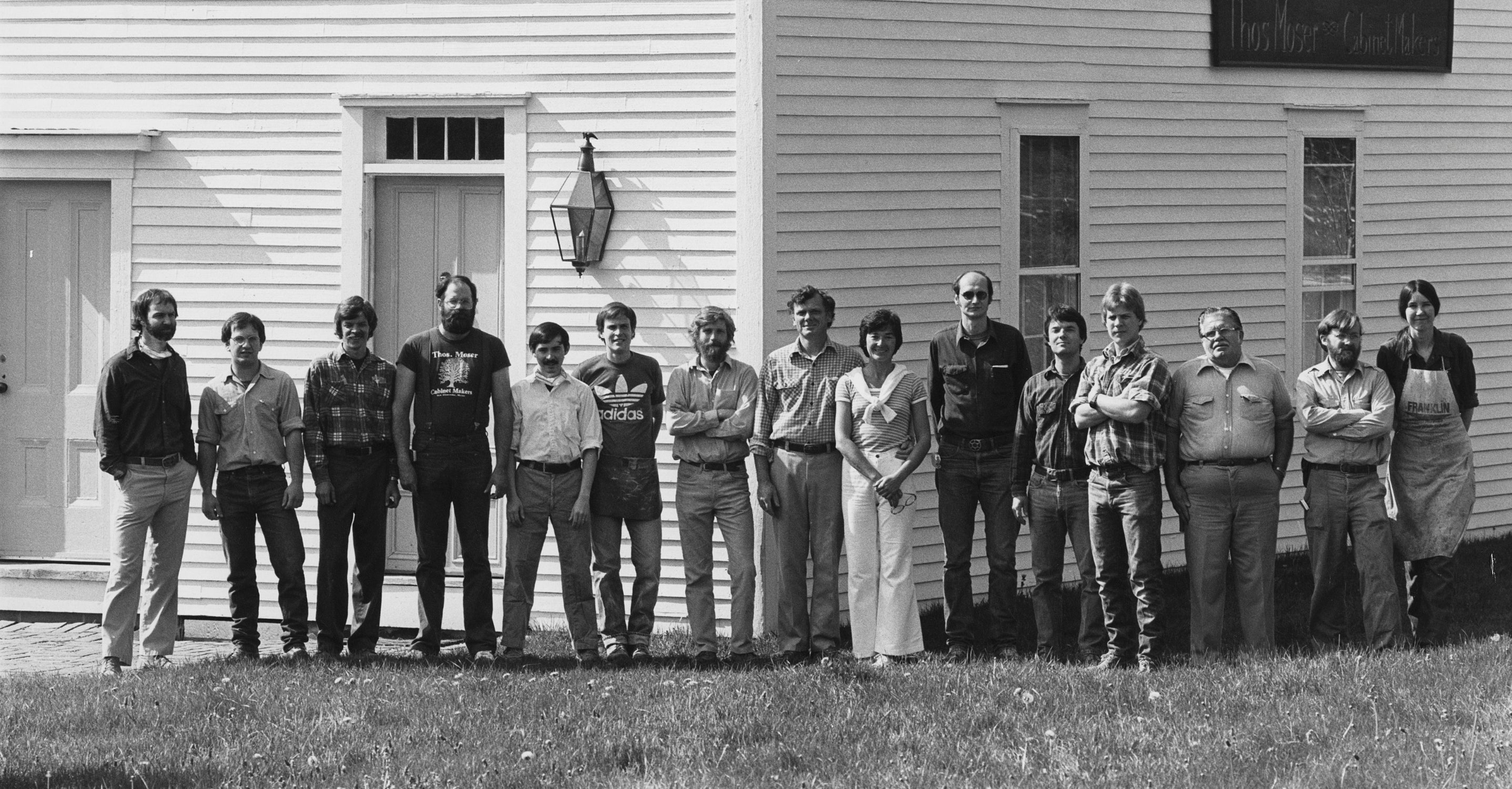
In 1972, Tom left his tenured teaching position at Bates College and, with his wife Mary by his side, opened a small woodworking shop in an old Grange Hall in New Gloucester, Maine. They called it Thos. Moser Cabinetmaker. There was no formal business plan, only an abiding love of wood and a belief in honest craftsmanship. From the beginning, each piece carried a promise—a satisfaction guarantee reflected Tom’s conviction that furniture, when made by hand with care and integrity, should last a lifetime. By 1973, with Mary Moser at the helm of marketing, among a laundry list of other duties, Thos. Moser placed its first advertisement in Down East magazine and The New Yorker, introducing a wider audience to furniture built with purpose, restraint, and heart.


A Vision for the Future
Throughout the 1970s and through the 1980s, the workshop quietly established its foundation. Innovation was never pursued for its own sake—it existed only to serve integrity and craft. In 1977, Thos. Moser began hand-signing every piece, a tradition that endures today as a mark of accountability and pride. That same year, Tom designed the Continuous Arm Chair, a form both sculptural and inviting, which became one of the company’s most enduring designs.
As demand grew for Tom's designs, so did the workshop. The first showroom, outside of Maine, opened in the early 1980s, and in 1987, the company moved into a larger workshop in Auburn, Maine, which remains the home base for our company to this day.


A Name Known Beyond Maine
By the 1990s and 2000s, Thos. Moser furniture reached far beyond New England. Tom’s son, David, joined the design process, introducing collections such as Vita, Pasadena, Wing, and Chaise, while classic pieces like the Harpswell and Auburn chairs became quietly iconic for their balance, restraint, and comfort.
In 2007, the company launched the Customer In Residence program, inviting customers into the workshop to build their own furniture alongside master craftspeople—a testament to the belief that making deepens connection and appreciation. Thos. Moser furniture has been requested for official ceremonies by Pope Benedict XVI and Pope Francis, chosen for presidential libraries by both Reagan and Bush, and now graces Ivy League campuses, public libraries, private schools, and homes worldwide. In 2018, the New York Public Library commissioned a chair that has become an enduring symbol of the institution.


Passing the Torch
In 2016, leadership passed to the next generation when Aaron Moser was named CEO, guiding the company forward while remaining rooted in its founding principles. In 2022, Thos. Moser marked its 50th anniversary—five decades of building furniture defined by thoughtful design, traditional joinery, and individual workmanship. In January 2025, after more than half a century of family stewardship, Thos. Moser entered a new chapter under a Maine-based company that aligned with its values of craftsmanship, sustainability, and long-term vision, ensuring the work remains grounded in place and purpose.

Crafted for Generations
From a single Grange Hall in New Gloucester to workshops, showrooms, and homes around the world, Thos. Moser's story is more than one of growth. It is a philosophy made tangible: that beauty lies within restraint; that integrity reveals itself over time, and that objects we live with should be built to last a lifetime.


