

Journal
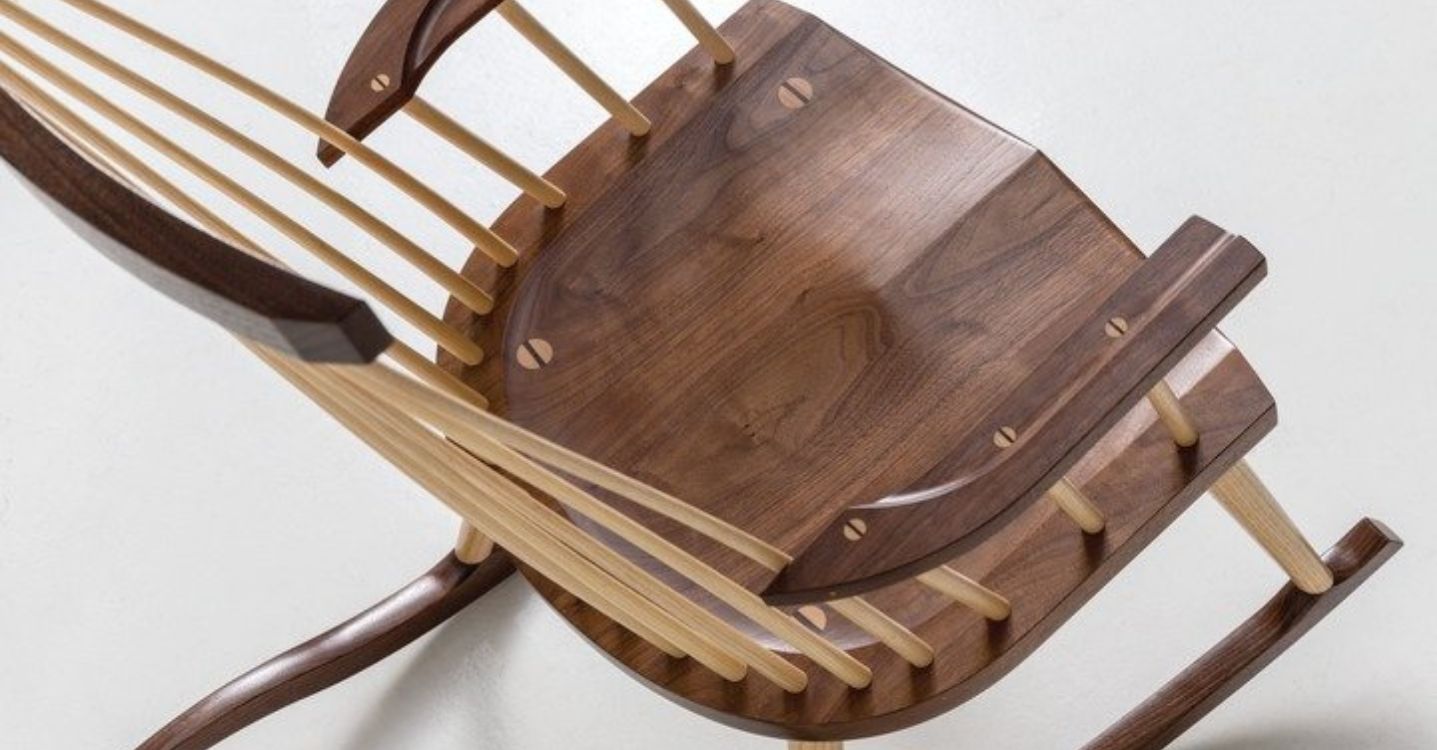

The New Gloucester Rocker
A rocking chair emanates nostalgia, a sense of comfort, relaxation, and a lulling quality made for front porches, tucked-away corners, and quiet nurseries. Seemingly encoded in our DNA, this gentle rocking motion has immediate palliative effects. Perhaps that is why, in 1982, a serendipitous commission allowed Tom to explore a design he had been toying with for several years. Above: Thomas Moser hanging the sign of our first Portland Showroom. At this time, we had our showroom in Portland on Cumberland Ave., and there was a wonderful antique store in the Old Port section of town. Well, I walked by the shop window one day, and there was a Windsor-style fan-back chair with a narrow crest and a wide seat. Almost all Windsor chairs are the opposite,” says Thomas Moser. “Well, this fan-back Windsor was the reverse; I had never seen anything like that before, and I can’t say as if I have ever seen anything quite like it again,” says Tom. “That chair really influenced me.” There were several forms Tom could draw inspiration from; a Shaker ladder-back rocker, the Boston Rocker, Salem, or mission-style rockers of California. The most well-known style in New England was the Boston Rocker. Contrary to its name, the first Boston rocker was built in Connecticut around 1825 by a man named Lambert Hitchcock. Hitchcock’s design took the Boston chair, a traditional fan-back style chair, and placed it upon two runners or rockers. The Boston rocker is most notable for its ornate carvings or floral paintings along the crest and decorative turned legs and spindles attached to a curved arm. The Salem rocker followed the Boston rocker in design with a slightly lower back and more angled seat. “I thought,” Tom says, “Why not do a Boston rocker where the spindles come into a smaller crest rail and engulf the sitter?” Other notable refinements to Tom’s “Boston Style” rocker include the floating arm. “I wasn’t particularly interested in creating a sack-back style rocking chair. That is to say, I didn’t want the arms to attach to the back of the chair,” he says. To maintain the light and airy profile, he designed a floating arm attached by wedged tenons to the front three spindles that barely touch the back, giving the illusion that the component is floating atop the spindles. As the chair needed to be big enough to hold a full-grown man, Tom knew he needed to create a wide seat. The seat of the Boston Rocker was narrow and scrolled. “The Salem Rocker had a much flatter and wider seat, and aesthetically, I was drawn to this simpler design,” says Tom. The final refinement to the design was the rockers themselves. Many early rocking chairs had short and thin rockers. Creating a balanced, sculptural, and robust rocker was paramount for a chair designed to withstand years of use. “The Shakers had what was called a suicide rocker. It was a ladder-back chair with very short and thin rockers, and if you went back far enough, you would topple over backward. So the detail in our design brings the chair back to the center, preventing that from happening. This detail exists on all our rockers,” notes Tom. “Since the chair was designed and built in our New Gloucester workshop, we called it the New Gloucester Rocker, and it became one of our signature pieces,” says Tom. The rocking chair, in its somewhat modern-day form, dates back to the early 1700s when the rockers were formed by attaching the blades from ice skates to the bottom of a chair. Since then, the rocking chair, a uniquely American design, has come a long way from its primitive beginnings. Today’s forms are modern and sleek, and complement any decor, creating a timeless heirloom for a contemporary space.
LEARN MORE
More Than Ink on Wood
Mason Faucher’s eight-year journey at Thos. Moser, starting in 2015, showcases his evolution from a woodworking graduate to a skilled, versatile craftsman.
LEARN MORE
A Golden Guide to Interior Design
The Golden Ratio, often seen as the 60/30/10 rule, guides interior design to create balanced, cohesive, and inviting spaces.
LEARN MORE
East Meets West
Our Eastward collection honors George Nakashima, whose clean designs revealed wood's raw beauty and deeply shaped our design ethos.
LEARN MORE
The Mower That Moved Us
In a field along Cobb’s Hill Road, across from the old vestry that served as Thos. Moser’s first showroom rests a rusted 1800s sickle bar mower. Frozen in place, it harkens back to a sweltering day in late August when a farmer sat upon its cast-iron seat, guiding a team of plow horses to harvest his final crop of hay. Throughout New Gloucester, country roads are dotted with these snapshots into the past. A glass gallon jar that once held haymaker's punch sits propped against the wheel of the tractor. Along these roads, we catch a glimpse of history when men and women worked the land, developing communities of self-sufficient farmers and craftspeople who settled into this landscape. Incorporated in 1774, New Gloucester, Maine, was a town comprised mostly of early settlers from Gloucester, Mass. Hence the name “New” Gloucester. Drawn to the rich soil, New Gloucester developed into a prosperous farming community. Resplendent with orchards, gardens, and wide-spreading elms, the early settlers utilized the land and its natural resources to support a growing population—including six sawmills, two tanneries, and gristmills. The Rise of "Working Comfortably." In the 1850s, as New Gloucester began to grow from its initial sixty inhabitants to nearly thirty times its size, the Industrial Revolution was taking shape, making significant advancements in technology for the farming community. Until the mid-1800s, farmers were still manually harvesting hay with sickles and scythes. The advent of the sickle bar mower was the first step in making the hot and dusty work of haying by hand less brutal, more efficient, more productive, and even more comfortable. Lending to these newfound machines’ comfort and productivity was a flat wooden board for a seat. In the mid-1850s, manufacturers began adding cast-iron supports to the wooden board, and by the 1860s, almost all tractors had seats made entirely of cast iron. The earliest version of the cast iron seat was solid— meaning they held water during inclement weather and became blistering hot as the tractor sat in the mid-day sun. Born from necessity, tractor companies began designing seats with holes for drainage and ventilation— creating a form of agrarian art. Artisans created the seat by first carving the shape and design in solid wood, and then, from that wooden mold, the seat was cast in iron. Over 100 years later, the purity and austerity of the traditional handwork in these iron seats captivated Tom Moser. In 1978, Tom began carving the first iteration of the High Stool, which he called the “studio stool.” Made from two or three, twelve-quarter blocks, the seat, cut from the same log to ensure color and grain match, reflects the old tractor seats and western saddles’ defining characteristics. The hand-sculpted seat features a rounded cantle, the back edge of the seat, and a gentle and smooth pommel to cradle the occupant. Unlike its industrial cousins, the High Stool makes no use of metal screws or bolts to hold the seat in place—the old iron seats would be attached to the tractor using a metal bolt and washer placed through the middle of the seat! In the High Stool, tapered ash legs, used for their tensile strength, pierce through the bottom of the seat and join the top with a wedged tenon made from either cherry or walnut, creating a conscious design moment. Once the tenon has dried, it is sanded to match the seat’s grade; the beautiful joinery creates a secure hold and unimpeded seat. The sculpted movement on the top of the stool travels over the rounded edges to the seat’s underside, where an inverted cut in front highlights the dramatic rise of the pommel. There is an inherent beauty to old farm machinery. Perhaps it’s the way the sunlight strikes the rusty hay rake and iron seat resting unmoved for decades in an open field. It’s a reminder of days long gone, when agriculture and hand-crafted items dominated the economy, and families made their living from the fertile land. In many ways, we have come back to celebrate this way of life that honors the local community and its farmers and values the sustainable beauty of a handmade piece of furniture that gets better with time and is made to be used for generations.
LEARN MORE
Great-Grandpa Joe's Bookshelf
Joseph Moser’s bookshelf, simple in design, stands as a cherished heirloom symbolizing four generations of family history and love.
LEARN MORE
The Birth of an Icon
Thos. Moser’s chair, crafted with the NYPL, embodies the Library’s mission and vision, transcending furniture to become a lasting symbol.
LEARN MORE
Inside the Thos. Moser Workshop
Step inside the 80,000 sq ft Thos. Moser workshop in Auburn, Maine, where every piece of our furniture begins its journey.
LEARN MORE