

Journal

Building Beyond Time
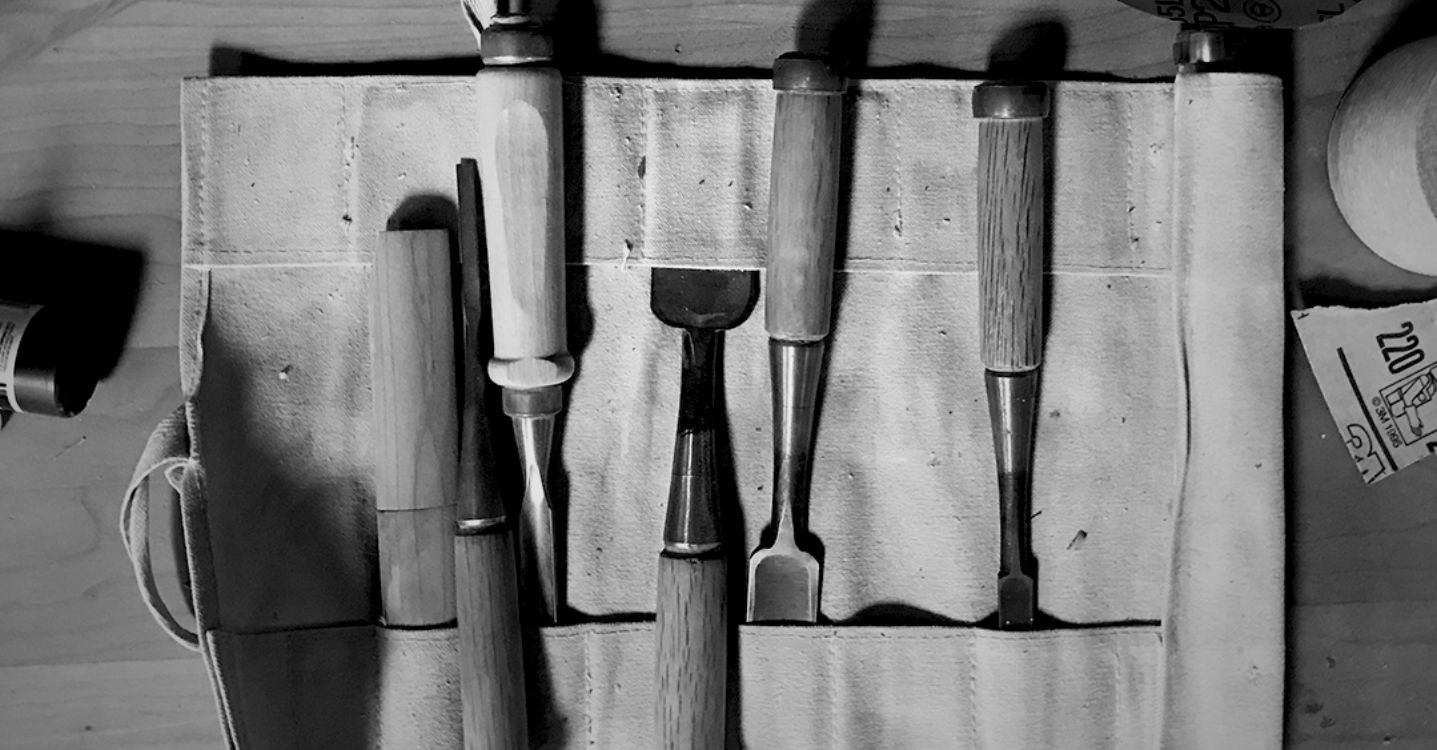
“I was overwhelmed by the amount of tools he had,” Nate Blackwell, craftsman at Thos. Moser, since 2023, recalls. As he and his father unlatched the door to his grandfather’s woodshop, they discovered stacks of old woodworking books with dog-eared pages and scribbled notes. The walls were lined with an encyclopedic collection of perfectly placed hand tools. Power tools and machines stood frozen in place from the last time they had been used, and piles of rough-sawn lumber were stacked against the walls. Nate’s grandfather, a self-taught woodworker, was enamored with the Shaker style of furniture making. He loved the simplicity of the designs and prescribed to the Shaker notion of using local wood, often building pieces in apple wood, maple, or oak. “The more character, knots or wormholes, the wood had, the more likely my grandfather was to use it,” he says. His grandfather was a prolific furniture maker, building chairs, dressers, side tables, bookshelves, and the dining table for his home. It's about making something out of nothing... creating form out of raw materials. -Nate Blackwell During the early 1970s, his grandfather joined a local woodworking club that met in New Gloucester, Maine. The club would get together every month to have coffee and talk shop. It was in this group that Nate’s grandfather met Tom Moser. Tom’s business was still in its infancy at this point, and, ever the student, Tom saw the woodworking club as a place to learn new techniques and approaches to working with wood. Nate recalls a story his aunt shared with him, saying, “There was a trestle table that my grandfather was working on and just couldn’t get it right. He mentioned this project in the woodworking group, and Tom told him to bring it to the Grange Hall shop, and they would work together. As Tom had more space and tools, Nate’s grandfather happily accepted the offer, and they finished the table together.” Nate doesn’t recall the extent of Tom and his grandfather’s friendship, but knows that the few times he spent in the Grange Hall shop and those woodworking club meetings were meaningful to him. It's not just about the technique—its about the artistry in shaping it. Above: The Grange Hall Workshop in New Gloucester Nate’s journey into woodworking began in his grandfather’s workshop. “I grew up in my grandfather’s wood shop, mostly just bothering him,” Nate laughs. “I remember holding things while he clamped or did a glue-up, but I was mostly sneaking away from my parents to get an A&W Root Beer. We were never allowed to have a soda as children, but when I helped my grandfather, he would let us have a soda. The smell of root beer still brings me right back to my grandfather’s shop.” Above: Nate works on shaping the arm of the Thos. Moser Continuous Arm Chair After spending a decade in agriculture, Nate decided to carve out a new career. He still wanted a job that allowed him to work with his hands, and when the opportunity at Thos. Moser arose; he knew he had to take it. As an integral part of the chair department, Nate creates the iconic arms of the Thos. Moser Continuous Arm Chair, in addition to building a vast catalog of chairs and benches. “It’s almost like sculpture,” he says, drawing from his background in 3D art. “There’s something incredibly satisfying about working with your hands to bring out a shape in the wood. You take a raw material, something square, and turn it into something graceful and functional. It’s not just about the technique—it’s about the artistry in shaping it.” Above: Photographs of his grandfather's furniture. When his grandfather passed, Nate salvaged much of the wood and hand tools from his shop, storing them away for a future he could barely imagine. “I never would have guessed I’d end up using his tools like this,” he says, “But here I am, using them to make furniture in the same style that inspired my grandfather’s work.” Above: A small collection of his grandfather's tools. The tools, the furniture, the techniques—they all carry a piece of him, and I want to keep that alive. -Nate Blackwell While it’s clear Nate is passionate about his craft, his emotional connection to his grandfather's tools runs deep. “Using his tools, it feels like he’s right there with me,” Nate shares. “They’re not just tools—they’re part of his legacy. When I look at the furniture I’m making now, I can’t help but think about how proud he’d be.” That feeling of connection extends beyond the tools themselves. For Nate, the idea of heirlooms has taken on a new meaning. “I’ve got pieces of his furniture in my home. My parents have more,” Nate says. “It’s not just furniture—it’s history. It’s his history, and now it’s my history.” Every piece I build, I think about how it might one day be passed down. Its about leaving a lasting mark—just like my grandfather did. For Nate, working at Thomas Moser isn’t just a job; it’s a continuation of a family tradition. “I’m building furniture that’s going to last,” he says with a smile. “And I’m doing it with the same tools my grandfather used. It’s like we’re building together, even though he’s been gone for years.” That sense of a family legacy is not lost on him. “When I signed my first piece of furniture here, it felt amazing,” he says. “Not just because I was proud of the work, but because my name is now on something that could last generations—just like the pieces my grandfather made.” Above: Nate's Grandmother and Grandfather.
LEARN MORE
The Shape of Wood
Curved wood in furniture—seen in table aprons, bed frames, and chair crests—is crafted through cutting, steam-bending, or lamination techniques.
LEARN MORE
The Thos. Moser Continuous Arm Chair
When Tom Moser embraced furniture making, he revived the Windsor chair with a modern design that became iconic for Thos. Moser.
LEARN MORE
The Harpswell Chair
Tom and Mary Moser didn’t fall in love with Maine the typical way. Before the arrival of their second son, they packed themselves, a tent, and a few provisions into their car for a long weekend. Being unfamiliar with the area and exhausted from a day of driving, they pulled over for the night and pitched their tent. Much to their chagrin, they awoke to a man’s voice saying they were blocking his driveway. Instead of being curt, the gracious man helped them move their tent aside and invited them to stay. They stayed for four days, and nearly thirty years later, they planted their roots on a spit of land not far from where they landed on that first trip to Maine. Above: Table Minimus - Oval & Harpswell Arm Chair with Back. Developing A Classic Around 1990, Tom strolled down the driveway to his Harpswell workshop and began working on a new chair design. He created a round chair with a quarter-round back, but he wasn’t happy with the initial result. After a bit more tinkering, the rounded seat became a U-shaped seat. “Eventually, I added a curve and tapered back leg,” Tom recalls. “And one day, I discovered that the round cafeteria chair I began making in my shop a few years before had morphed into this very pleasing piece.” The new design’s most magnificent appeal was an exuberant back carved from a solid piece of wood that intentionally displays the wood's natural beauty, where no two are alike, revealing the mark of an heirloom. Eventually, the chair would incorporate an upholstered slip seat that rests directly in the chair’s frame and an often-requested upholstered back. Above: Tom Moser in his workshop. From Humble Beginnings to Dignified Design Aptly named after the location of his home studio, the Harpswell Chair was introduced in 1992 and became an instant classic. Its modest cafe chair design and refined details bring quiet distinction to any space. The versatility of the durable Harpswell Chair has made it a favored choice for countless family dining rooms, community colleges, and Ivy League libraries. In 2008, the Harpswell Arm Chair would be selected as Papal seating and chosen as the signature piece to grace the George W. Bush Presidential Center in 2013, where, during the dedication, five living presidents would be comfortably seated. Above: The Harpswell Chair at the opening of the Presidential Library and the chair for the Papal visit. Incorporated in 1758, the town of Harpswell boasts the longest coastline of any town in Maine. This rugged coastline, purchased with a pound of tobacco and a gallon of rum, has cultivated generations of self-sufficient families who worked with their hands; fishers, farmers, shipwrights, and now, a furniture maker. From the humble beginnings of a simple cafe chair to a dignified design sought after by Popes and Presidents, the Harpswell Chair is a natural fit for every home and any occasion. The expressed growth rings found in the crest celebrate the weathered-tested years of a strong tree and embody the spirit of a community nestled along this section of granite coastline known as Harpswell. Tom and Mary Moser at their home in Harpswell.
LEARN MORE
The New Gloucester Rocker
A rocking chair emanates nostalgia, a sense of comfort, relaxation, and a lulling quality made for front porches, tucked-away corners, and quiet nurseries. Seemingly encoded in our DNA, this gentle rocking motion has immediate palliative effects. Perhaps that is why, in 1982, a serendipitous commission allowed Tom to explore a design he had been toying with for several years. Above: Thomas Moser hanging the sign of our first Portland Showroom. At this time, we had our showroom in Portland on Cumberland Ave., and there was a wonderful antique store in the Old Port section of town. Well, I walked by the shop window one day, and there was a Windsor-style fan-back chair with a narrow crest and a wide seat. Almost all Windsor chairs are the opposite,” says Thomas Moser. “Well, this fan-back Windsor was the reverse; I had never seen anything like that before, and I can’t say as if I have ever seen anything quite like it again,” says Tom. “That chair really influenced me.” There were several forms Tom could draw inspiration from; a Shaker ladder-back rocker, the Boston Rocker, Salem, or mission-style rockers of California. The most well-known style in New England was the Boston Rocker. Contrary to its name, the first Boston rocker was built in Connecticut around 1825 by a man named Lambert Hitchcock. Hitchcock’s design took the Boston chair, a traditional fan-back style chair, and placed it upon two runners or rockers. The Boston rocker is most notable for its ornate carvings or floral paintings along the crest and decorative turned legs and spindles attached to a curved arm. The Salem rocker followed the Boston rocker in design with a slightly lower back and more angled seat. “I thought,” Tom says, “Why not do a Boston rocker where the spindles come into a smaller crest rail and engulf the sitter?” Other notable refinements to Tom’s “Boston Style” rocker include the floating arm. “I wasn’t particularly interested in creating a sack-back style rocking chair. That is to say, I didn’t want the arms to attach to the back of the chair,” he says. To maintain the light and airy profile, he designed a floating arm attached by wedged tenons to the front three spindles that barely touch the back, giving the illusion that the component is floating atop the spindles. As the chair needed to be big enough to hold a full-grown man, Tom knew he needed to create a wide seat. The seat of the Boston Rocker was narrow and scrolled. “The Salem Rocker had a much flatter and wider seat, and aesthetically, I was drawn to this simpler design,” says Tom. The final refinement to the design was the rockers themselves. Many early rocking chairs had short and thin rockers. Creating a balanced, sculptural, and robust rocker was paramount for a chair designed to withstand years of use. “The Shakers had what was called a suicide rocker. It was a ladder-back chair with very short and thin rockers, and if you went back far enough, you would topple over backward. So the detail in our design brings the chair back to the center, preventing that from happening. This detail exists on all our rockers,” notes Tom. “Since the chair was designed and built in our New Gloucester workshop, we called it the New Gloucester Rocker, and it became one of our signature pieces,” says Tom. The rocking chair, in its somewhat modern-day form, dates back to the early 1700s when the rockers were formed by attaching the blades from ice skates to the bottom of a chair. Since then, the rocking chair, a uniquely American design, has come a long way from its primitive beginnings. Today’s forms are modern and sleek, and complement any decor, creating a timeless heirloom for a contemporary space.
LEARN MORE
The Aging Process of Cherry
Cherry furniture deepens from light salmon to rich reddish-brown within months, its unique finish inviting a tactile connection through time and touch.
LEARN MORE
Natural Variations Found in North American Hardwood
Discover the natural variations in North American hardwood—aging color, grain patterns, and mineral deposits—that make each Thos. Moser piece unique.
LEARN MORE
Coastal Cottage Offers Modern Retreat
The moment you turn down the nearly half-mile private driveway to the Jennings cottage, you know you are about to experience something magical.
LEARN MORE